Grip Face: A Letter Lost in the Offline Refuge: Solo Exhibition
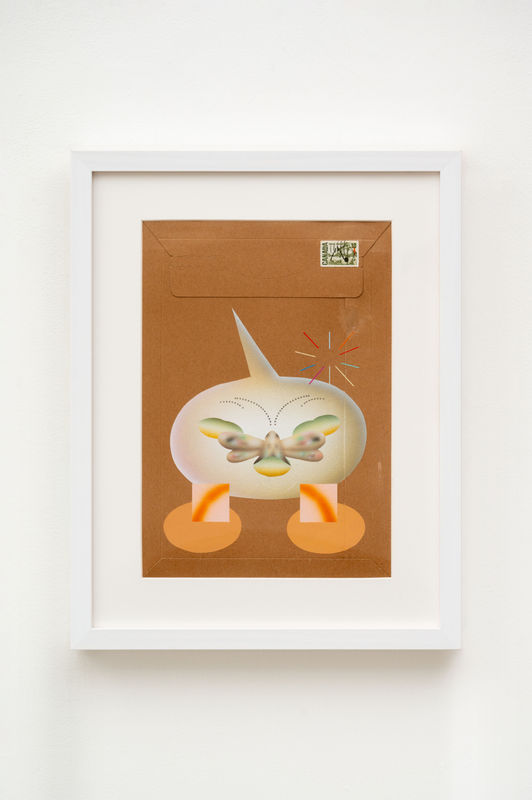
Tripping in the Age of Brain Rot — On the Work of Grip Face
Text/ Sid CHEN
When I look at the paintings of Spanish artist Grip Face (David Oliver), I feel as though I am observing how elements from different dimensions and contexts unfold simultaneously on a single plane. At the edges, digital brushstrokes, lines, fills, gradients, and pixelation recall the tools of Microsoft Paint. At the center, the composition often features a face covered in multicolored hair, meticulously outlined with fine, intricate strokes-what the artist calls the "Sandpaper Face." According to his personal introduction, this was a nickname given to him by his inline-skating friends during his teenage years in the early 2000s.
Born in 1989 in Palma, Spain, Grip Face creates paintings with a sweet, absurd, and contradictory energy. His use of color and technique shifts between different spatial expressions, revealing a collage-like condition that intertwines fetish, the digital, and a tension between concealment and exposure. Earlier this year, he held a solo exhibition, Utopía del Lodo y Sashimi de Bruma, at Espai Cúbic of the Fundació Miró Mallorca. At this pivotal moment in his career, he now brings his first solo exhibition to Taiwan.
Before becoming an artist, Grip Face was deeply shaped by millennial youth culture-inline skating in the streets, immersion in comic books, losing himself in the craftsmanship of Japanese animation, listening to pop music through MP3 players, and surrounding himself with the plastic toys that filled his private world. His artistic, aesthetic, and visual education took place across both the private and public spaces of his generation, forming a multifaceted and fluid artistic practice. Perhaps it is precisely this fluidity that informs the shifts across the various interfaces in his paintings.
In his upcoming solo exhibition at YIRI ARTS, Grip Face presents several new works that combine acrylic and oil, showcasing some of his most recognizable visual vocabulary. In Low Study, he uses hand-painting to deliberately interpret "imprecise" digital pixel brushes and flat color fills, alongside the lush rendering of the Sandpaper Face and the smooth gradients of color. The figure's gender is indeterminate; they gaze toward a cigarette in the lower left corner and the flame rendered in a different painterly mode, suggesting a sense of imminent danger. Yet the figure remains expressionless-or at least unreadable-watching everything unfold as though viewing a short disaster clip on a smartphone. The artist seems to depict the "brain-rot state" that many people fall into while endlessly scrolling through digital feeds.
Of course, Grip Face's work is not necessarily about recreating this brain-rot experience. Rather, he offers another way of showing how contemporary media dissociates our perception of reality within a single pictorial plane. The following threads, which appear throughout his sculptures, paintings, drawings, and spatial installations, offer insight into this approach.
The first concerns the methods and intentions behind masking the face. In 2022, when his works Masks of a Hedonistic Generation #01 & #02 were first shown to Taiwanese audiences in the group exhibition Ugly, Grip Face directly invoked the idea of "masks of a hedonistic generation"-two figures wrapped in white, revealing only their eyes and mouths-to explore the boundaries between moral concealment and exposure. In the new works, the Sandpaper Face seems to function as a fetishistic mask that anonymizes the figure, or perhaps as an online anonymous account that enables actions inaccessible to one's everyday identity.
It can be understood as costuming, makeup, or role-shifting. People do not possess only one version of themselves; costuming allows identities to perform alternative expressions across cultural and gender contexts. In Stuzz Moon, the figure reveals another of the artist's playful compositional strategies: a doll-like character dancing in the foreground blocks part of the portrait, while the distorted black dots spelling "stuzz moon" occupy the top visual layer, and small graffiti marks tease and disrupt the original face beneath.
Although the artist has not offered an official explanation, Grip Face uses the term "stuzz," a word connected to psychedelic drug culture. One might read this as a light, playful way of depicting a journey (a "trip") between dissociation and reconstruction-a 21st-century psychedelic state that drifts between reality and the digital, shifting through multiple media. In contrast to the vibrant sexuality, music, and hippie aesthetics of 20th-century psychedelia, this new form feels cooler in its gender expression-an emerging, contemporary psychedelic sensibility surrounding our world today.
Grip Face employs several contemporary techniques of painting and color, yet his aim is not simply to explore the possibilities of visual or chromatic logic within the field of art. Instead, he appears more interested in articulating the chaos and contradictions of the contemporary world-delivered with a clarity and absurdity that are distinctly his own.


-
 Grip Face, Paraíso de azufre y utopía de pantano, 2025
 -
Grip Face, Low Study, 2025
-
Grip Face, Nobo Garden, 2025
-
Grip Face, MAWM avatar, 2025
-
Grip Face, Utopia in the mud garden, 2025
-
Grip Face, Fuck War , 2025
-
Grip Face, Stuzz Moon, 2025
-
Grip Face, Atrapada en tu jardín, 2025
-
Grip Face, MI AVATAR DE DEFENSA, 2025
-
Grip Face, Dystopian Avatar #01, 2025
-
Grip Face, Dystopian Avatar #02, 2025
-
Grip Face, Dystopian Avatar #03, 2025
-
Grip Face, Jardín de bruma #01, 2025
-
Grip Face, Jardín de bruma #02, 2025
-
Grip Face, Jardín de bruma #03, 2025
-
Grip Face, Fotosintésis onírica #05, 2025
-
Grip Face, Mi amuleto pas, 2025


