Limbus Laboris: Two-Person Exhibition
Current exhibition
Overview

黃博志 Huang Po-Chih
Blue Elephant–Mother, “A floatness dream rising from my slim collar breath.”, 2018
Photography
Giclee on Canson® Infinity ARCHES® 88 310gsm
Giclee on Canson® Infinity ARCHES® 88 310gsm
100 x 90 cm
Edition 1/3
Limbus Laboris positions labor as an unstable category, particularly when it no longer operates within a logic of productivity that promises growth. Through the practices of Huang Po-Chih and Widi Asari, this exhibition examines two closely related conditions: labor as a production machine that organizes bodies and imagination within the textile industry, and labor as the management of residue when that system can no longer guarantee material or social sustainability. Textile here functions as an infrastructure through which capitalism, labor migration, and ecological crisis operate at the level of the body and material. If Po-Chih traces how labor is mobilized and extracted within transnational production networks, Widi observes the condition after such intensity recedes when what remains is matter that must be held, stored, and managed without certainty of direction. The exhibition maintains this limbus as a reflective space.
In Huang Po-Chih's practice, textile serves as an entry point into the history of industrialization in East Asia and the economic transformation of Taiwan. Through the personal narrative of his mother's experience as a garment worker, Po-Chih traces how women's bodies were integrated into production lines and absorbed into transnational economic machinery. His projects move beyond documentation by reconstructing situations of production as critical devices. Labor emerges as a mechanism that shapes bodily posture, migration patterns, and collective imaginaries of progress. Textile is not neutral; it carries traces of state policy, productivity propaganda, and the shifting centers of manufacturing across regions. Labor appears as an organized and measured system that continuously demands endurance.
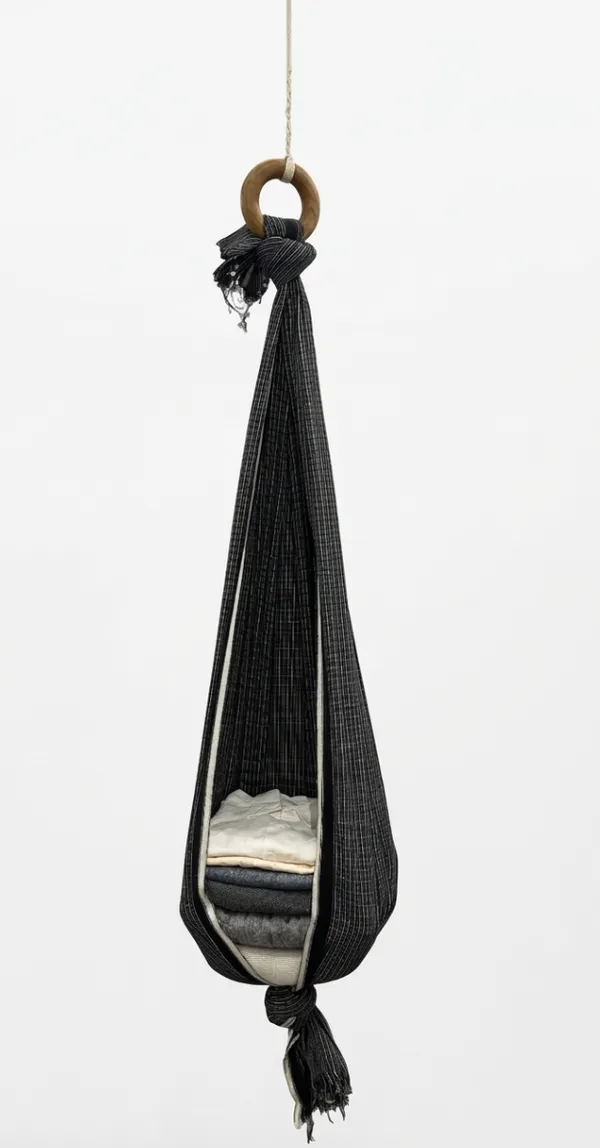
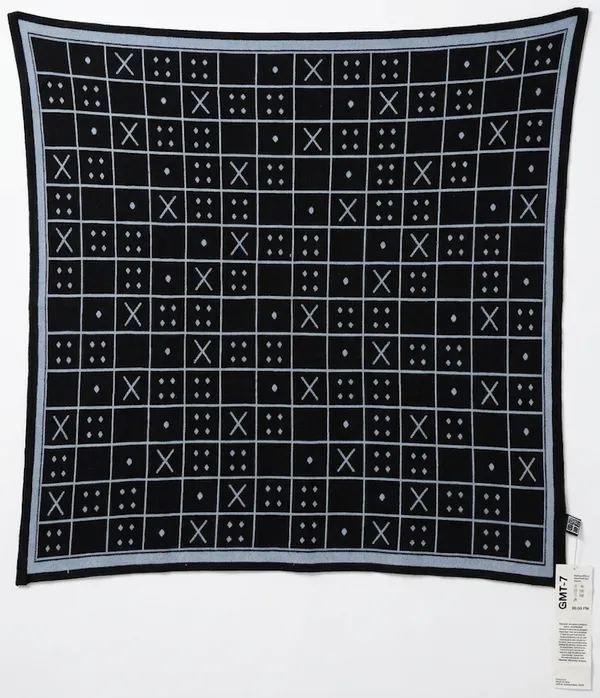
In contrast, Widi Asari's practice operates in a phase where productivity no longer serves as the central logic. The fabrics in her work are not directed toward commodity production or image-making; they are suspended, folded, and enveloped. Her approach stems from a re-reading of myth as a system of labor knowledge, not to restore its authority, but to test its relevance within conditions of ecological crisis and material overproduction. Widi shifts attention from production intensity to the management of leftovers. Labor appears as a minimal action: to preserve, delay, and regulate so that material does not immediately collapse into waste. In this context, textile functions as matter positioned at the threshold between use and discard.
The encounter between these two practices does not produce a conceptual synthesis, but reveals a tense continuity. Huang exposes how labor is mobilized and exhausted within industrial systems; Widi demonstrates how labor mutates when such systems can no longer absorb the material and energy they generate. The threshold invoked in Limbus Laboris is not metaphorical but structural: labor that has lost the stability of progress-driven narratives, yet still requires management. Between production and residue, between intensification and suspension, the exhibition proposes textile as an indicator of shifting forms of labor within contemporary capitalism.
Written by
M. Ari Nugraha
Program & Project Development
YIRI ARTS JAKARTA
Program & Project Development
YIRI ARTS JAKARTA
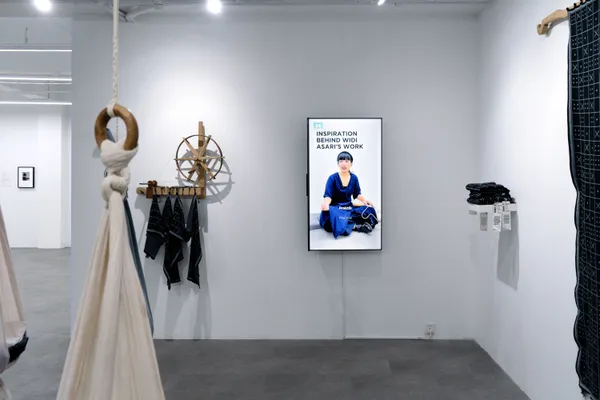
Installation Views




Works
-
 黃博志 Huang Po-Chih, Blue Elephant–Mother, “A floatness dream rising from my slim collar breath.”, 2018
 -
黃博志 Huang Po-Chih, Blue Elephant–Mother, “Wanting falls around me. Heavy garment, but I can be a floating elephant in my dream.”, 2018
-
黃博志 Huang Po-Chih, Blue Elephant–Ms. Kim, “I'm trying on each passing dream for size.”, 2018
-
黃博志 Huang Po-Chih, Blue Elephant–Ms. Kim, “I'm hiding from the sweating rain.”, 2018
-
黃博志 Huang Po-Chih, Blue Elephant–Ms. Kim, “I’m learning to deal with the working weight.”, 2018
-
黃博志 Huang Po-Chih, The Elephant in the Closet-01, 2025
-
黃博志 Huang Po-Chih, Eightday in the Sky, 2025
-
黃博志 Huang Po-Chih, Eight Days a Week, 2024
-
黃博志 Huang Po-Chih, Eightday on Paper, 2025
-
黃博志 Huang Po-Chih, Let It Rain, Let It Rain., 2024
-
黃博志 Huang Po-Chih, Salty Like the Sea, 2023
-
黃博志 Huang Po-Chih, The Blue Skin, 2023
-
黃博志 Huang Po-Chih, You Are a Blue Elephant, 2021
-
黃博志 Huang Po-Chih, Eightday Dropped on the Floor, 2025
-
黃博志 Huang Po-Chih, Eightday, 2024
-
Widi Asari, Selusin Lemari Darurat (02), 2026
-
Widi Asari, Selusin Lemari Darurat (03), 2026
-
Widi Asari, Kincir Lusi Pakan Sumbi, 2020
-
Widi Asari, Selusin Lemari Darurat (01), 2026
-
Widi Asari, Selusin Lemari Darurat (04), 2026
-
Widi Asari, Selusin Lemari Darurat (05), 2026
-
Widi Asari, Selusin Lemari Darurat (06), 2026
-
Widi Asari, Selusin Lemari Darurat (07), 2026
-
Widi Asari, Selusin Lemari Darurat (08), 2026
-
Widi Asari, Selusin Lemari Darurat (09), 2026
-
Widi Asari, Kain Kolenjer (GMT+7, 05.06 PM), 2023
-
Widi Asari, Selusin Lemari Darurat (10), 2026
-
Widi Asari, Selusin Lemari Darurat (11), 2026
-
Widi Asari, Selusin Lemari Darurat (12), 2026
-
Widi Asari, Kain Kolenjer (GMT+7, 05.02 PM), 2023
-
Widi Asari, Caor Sumbi, GMT+7 (05.08 PM), 2026
-
Widi Asari, Kain Kolenjer (GMT+7, 05.07 PM), 2023