Naufal Abshar : Meanwhile: Solo Exhibition
Meanwhile, Dysregulated Everyday: On Naufal Abshar's Serial Painting
Text by Sid Chen
Today, the space between our gazes is saturated with all kinds of information. We look at content on social media, and through these fragments we imprint images of others and of the world onto ourselves. It becomes difficult to directly perceive one another's real states through eye contact alone. In his solo exhibition "MEANWHILE," Indonesian artist Naufal Abshar presents a group of new works that collectively resemble a theater of everyday life. Through a retro-contemporary visual aesthetic, they point to this condition of the present.
From early in his practice, Abshar has, at times humorously and at times quietly, captured with precision the simultaneity and shared emotions among people today. From the HAHA series (2014), PUZZLE PAINTING, and TIMES series to the more recent DAY TO DAY series, the sense of seriality in his work has consistently followed his perception of the times and contemporary atmosphere. His paintings assemble images shaped by ambient moods and displaced information, rendered in vivid, saturated, and distinctive colors and outlines. The figures carry humorous yet nuanced emotional states, forming a wandering theater of urban daily life. MEANWHILE (2025), composed of large-scale mixed-media paintings, resembles a panoramic image constructed like collaged notes, layering fragments of life, consumer society, materiality, commodities, and imagery, and staging the realities and universality the artist seeks to address.
Abshar's work integrates the narrative qualities of illustration and serial art, alongside a painterly approach shaped by his distinctive aesthetic background. He draws on the spirit of Political Pop in postwar Indonesian art history, transforming it into a universal language with a global perspective. The humor in his work is a transformation and elevation of the critical capacity inherent in art. If one of the aesthetic values of painting today lies in the artist's ability to fold and translate reality beyond logic and language within a finite surface, Abshar is undoubtedly an artist to note. In this selection of new works, he departs from everyday connections between the world and Taiwan, adopting a humorous, storyteller-like perspective and editorial-style compositions. Through processes of recomposition, editing, and concealment across different media, scenes of daily life reveal both the absurdity and warmth characteristic of contemporary society. On this basis, the aesthetics of the everyday and repetition in his work may be understood as operating within a postmodern condition of "dyschronia."
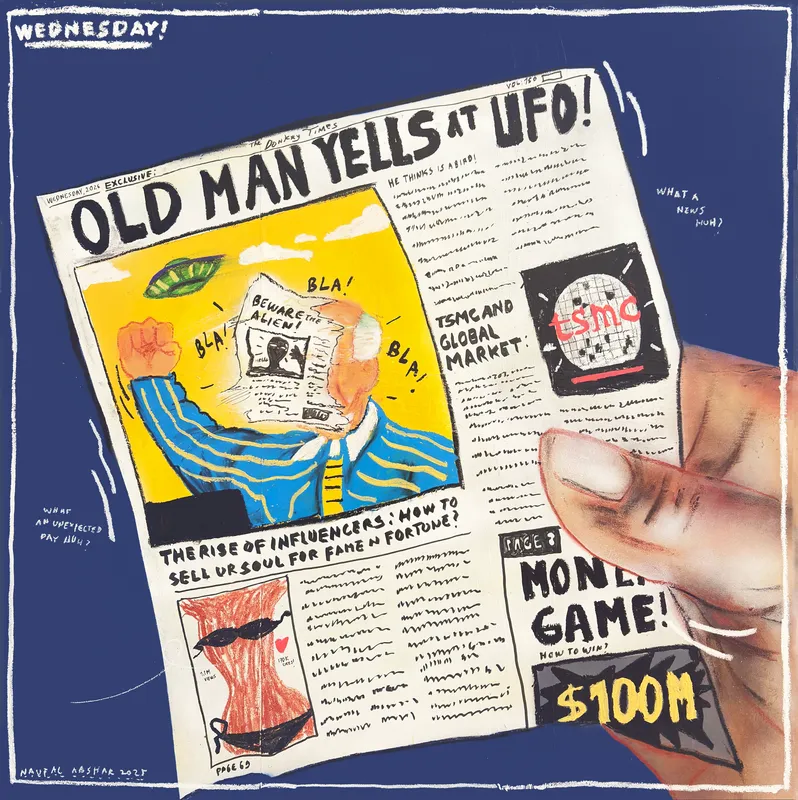
On this point, British contemporary thinker Mark Fisher offers a useful description: taking the example of Adele's widespread success, he notes that while her music is not marketed as retro, it does not feel specifically of the twenty-first century either. Her songs carry a vague yet persistent sense of the past, without referring to any particular historical moment. A similar quality can be observed in Abshar's work. His images are permeated by a sense of "old time" and "old money" urban modernity-terms that, in themselves, now carry a certain temporal character. In the attire of his figures, one often notices contrasting striped garments. Beyond creating a visually distinct color space within the composition, these stripes evoke a desire for modern, urban life. They also reference a material culture of modernity: since the 1920s, striped clothing gained global popularity through celebrity fashion, evolving from bankers' attire into a symbol of authority and style.
By using a sense of the past to narrate the present, Abshar gestures toward the value of slowing down in everyday life. As the small-scale work OFFLINE IS THE NEW ULTIMATE LUXURY suggests, being offline becomes a new form of ultimate luxury. In his paintings, people drive gasoline-powered cars rather than hybrid vehicles, and read newspapers and magazines instead of mobile devices. Although the figures inhabit a modern urban setting, the information and issues they receive through traditional media remain contemporary. What obscures the exchange of gazes between viewer and subject are layers of newspapers and the reflected information on sunglasses. Many works are marked with the day of the week, suggesting that daily life is formed through fluctuations of mood, repetition and interruption, occurrences and resolutions, and moments between busyness and rest. Such seemingly mundane routines, especially in the aftermath of the pandemic and amid ongoing conflicts worldwide, appear all the more precious.


-
 Naufal Abshar 納法爾・阿布沙爾, Meanwhile, 2025
 -
Naufal Abshar 納法爾・阿布沙爾, Meanwhile, 2025
-
Naufal Abshar 納法爾・阿布沙爾, I Need My Life Back 4 a Day|, 2025
-
Naufal Abshar 納法爾・阿布沙爾, Where’s the Hell Is Friday?, 2025
-
Naufal Abshar 納法爾・阿布沙爾, Offline Is the New Ultimate Luxury, 2025
-
Naufal Abshar 納法爾・阿布沙爾, Old Man Yells at UFO, 2025
-
Naufal Abshar 納法爾・阿布沙爾, Blindspot, 2025
-
Naufal Abshar 納法爾・阿布沙爾, AI Ask Human for Advice, 2025
-
Naufal Abshar 納法爾・阿布沙爾, The Kultural Reader, 2025
-
Naufal Abshar 納法爾・阿布沙爾, Its Matter of Perspective , 2025
-
Naufal Abshar 納法爾・阿布沙爾, Good Deal, 2025
-
Naufal Abshar 納法爾・阿布沙爾, Margin Call, 2025
-
Naufal Abshar 納法爾・阿布沙爾, You’re Late!, 2025
-
Naufal Abshar 納法爾・阿布沙爾, I Am Tranied for This, 2025
-
Naufal Abshar 納法爾・阿布沙爾, Risk Is Better Than Regret, 2025
-
Naufal Abshar 納法爾・阿布沙爾, There's Always a Hope, 2025
-
Naufal Abshar 納法爾・阿布沙爾, Fuck Life, 2025
-
Naufal Abshar 納法爾・阿布沙爾, The End , 2025
-
Naufal Abshar 納法爾・阿布沙爾, How Far Can Asia Keep Up, 2025
-
Naufal Abshar 納法爾・阿布沙爾, Trust Yourself No One Else but You, 2025
-
Naufal Abshar 納法爾・阿布沙爾, Do Not Give Up , 2025


