Iseult Perrault: Domestic Nature: Solo Exhibition

For her first solo exhibition in Taipei, Iseult Perrault presents Domestic Nature, a painted installation built on an intentional paradox: the desire to contain the landscape while acknowledging that it can never truly be contained. The title functions as an oxymoron-an encounter between the domestic and the wild, the interior and the exterior, the known and the unreachable. Painting becomes the ideal medium for this union: a space where contradictions can coexist and where imagined nature can fully materialize within a controlled frame.
The exhibition unfolds through a series of acrylic paintings, all sharing the same vertical format (100 × 60 cm). By adopting a fixed format and a cinematic hanging line, the artist mimics systems of normalization, repetition, and digital consumption. The canvas becomes an interface, a module, a visual rhythm that recalls scrolling and the almost mechanical pace at which contemporary landscapes are absorbed and immediately replaced by the next image.
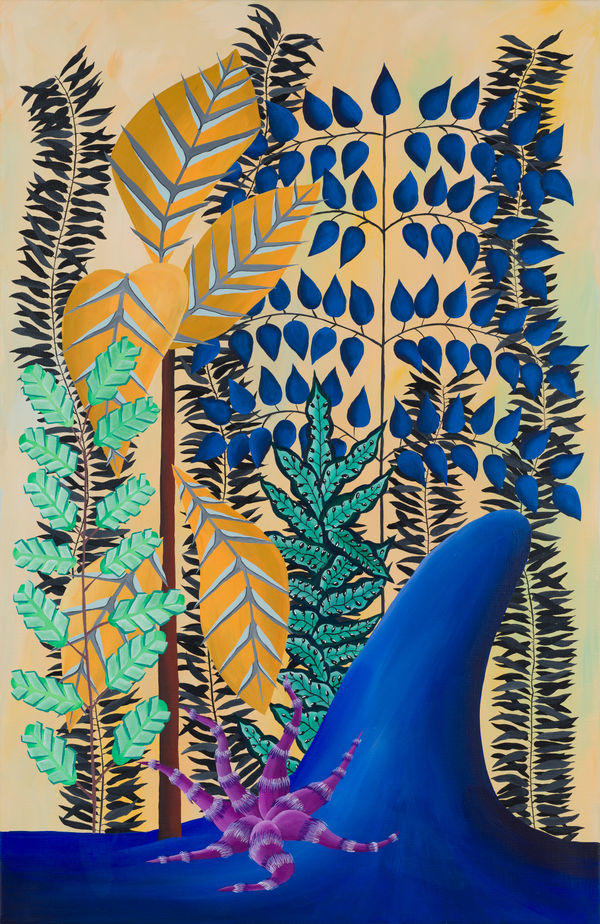
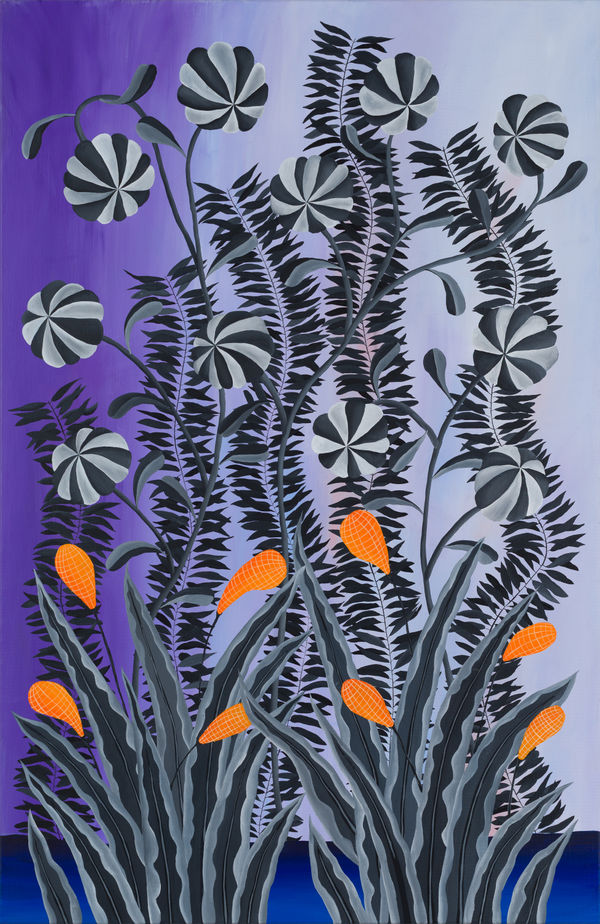
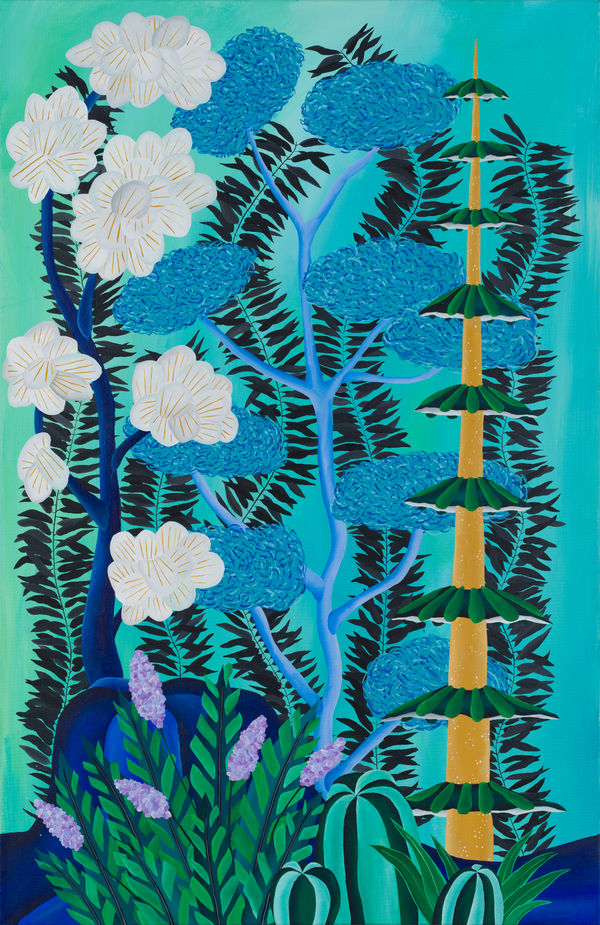
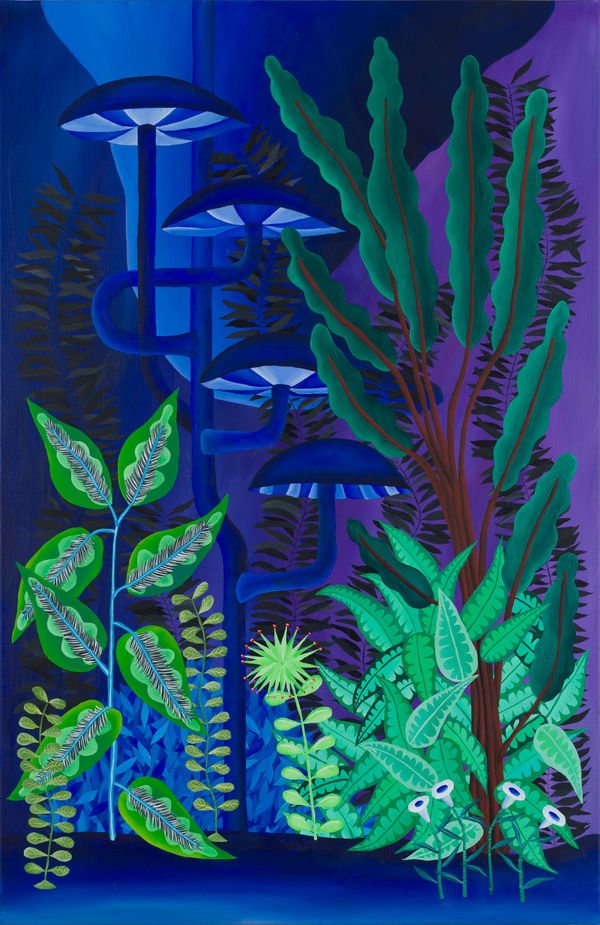
Each painting represents a fragment of a single garden-one that expands beyond its physical limits. There is no central viewpoint, only sections of a world in perpetual growth. What holds these fragments together is a blue substrate that shifts from one painting to the next. At once liquid and solid, this blue evokes something essential yet unstable, familiar yet impossible to name. It is magical, post-natural, and mutating. Acting as the visual glue of the series, it preserves the singularity of each painting while behaving like a wave, a frequency, or a pulse-adapting to the conditions of each canvas and continuously modulating them.
The garden itself is composed of plant forms collected by the artist in nature or extracted from digital sources, then hybridized with invented species and synthetic motifs. These are not representations of nature, but recompositions of it. The paintings do not imitate the natural world; they fictionalize it in order to question what "landscape" means today. Here, fiction is not escapism but a critical tool, exposing the artifice behind our cultural construction of nature.
The exhibition display extends this logic spatially. The canvases are arranged in one continuous, evenly spaced horizontal line, unfolding like the fixed frames of a film strip. This montage is activated by the movement of the viewer, producing a stop-motion effect similar to a flipbook. The garden animates itself at the speed of the gaze, while the blue substrate transforms across paintings, generating a sense of acceleration and evolution-as though the landscape were turning its own pages.
Perrault conceives Domestic Nature as a painting installation that surrounds the viewer, placing them at the center of a panoramic environment. Almost encircled by the landscape, the spectator becomes a witness to a rapidly mutating nature-one that echoes a world increasingly shaped by climate emergency and post-natural conditions. This acceleration mirrors a broader struggle: a nature forced to adapt continuously to what humanity still allows it to occupy.
In Iseult Perrault's work, landscape is never décor. It is a living thought-exercise-a poetic terrain where magic becomes method, repetition becomes rhythm, and fiction becomes a lens through which to confront reality, with all its urgencies, contradictions, disappointments, and hopes.


-
 Iseult Perrault 伊瑟爾・佩羅, Domestic Nature - piece A, 2026
 -
Iseult Perrault 伊瑟爾・佩羅, Domestic Nature - piece B, 2026
-
Iseult Perrault 伊瑟爾・佩羅, Domestic Nature - piece C, 2026
-
Iseult Perrault 伊瑟爾・佩羅, Domestic Nature - piece D, 2026
-
Iseult Perrault 伊瑟爾・佩羅, Domestic Nature - piece E, 2026
-
Iseult Perrault 伊瑟爾・佩羅, Domestic Nature - piece F, 2026
-
Iseult Perrault 伊瑟爾・佩羅, Domestic Nature - piece G, 2026
-
Iseult Perrault 伊瑟爾・佩羅, Domestic Nature - piece H, 2026
-
Iseult Perrault 伊瑟爾・佩羅, Domestic Nature - piece I, 2026
-
Iseult Perrault 伊瑟爾・佩羅, Domestic Nature - piece J, 2026
-
Iseult Perrault 伊瑟爾・佩羅, Domestic Nature - piece K, 2026
-
Iseult Perrault 伊瑟爾・佩羅, Domestic Nature - piece L, 2026
-
Iseult Perrault 伊瑟爾・佩羅, Domestic Nature - piece M, 2026
-
Iseult Perrault 伊瑟爾・佩羅, Domestic Nature - piece M, 2026
-
Iseult Perrault 伊瑟爾・佩羅, Domestic Nature - piece N, 2026
-
Iseult Perrault 伊瑟爾・佩羅, Domestic Nature - piece O, 2026